Carrier Ethernet
Enterprise-Grade Ethernet Services for Mission-Critical Applications
Overview
Carrier Ethernet represents the evolution of traditional Ethernet technology into a carrier-grade transport service suitable for telecommunications providers and enterprise networks. Carrier Ethernet extends standard Ethernet capabilities through the addition of essential service quality, management, and operational features required for mission-critical applications and service provider deployments.
Unlike best-effort IP networks, Carrier Ethernet provides deterministic service delivery with guaranteed bandwidth, low latency, defined packet loss rates, and comprehensive end-to-end operations and management capabilities. This convergence of Ethernet simplicity with carrier-grade reliability has positioned Carrier Ethernet as the dominant technology for modern telecommunications infrastructure.
Defining Characteristics
Standardization & Interoperability
Carrier Ethernet is standardized through the IEEE 802.1 and MEF (Metro Ethernet Forum) frameworks, ensuring equipment interoperability across multiple vendors and implementations.
- •IEEE 802.1Q - VLAN tagging and switching
- •IEEE 802.1ad - Provider Bridges (Q-in-Q)
- •MEF 21 - E-LAN and E-Line services
Simplicity & Efficiency
Ethernet's architectural simplicity and ubiquity make Carrier Ethernet an economically attractive alternative to legacy circuit-oriented technologies.
- •Low implementation complexity
- •Reduced operational overhead
- •Lower cost per Mbps of transport capacity
Service Models
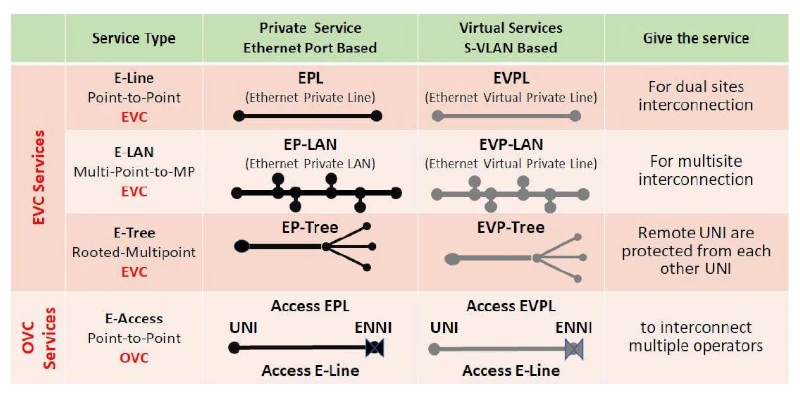
Carrier Ethernet is organized into standardized service types, each providing specific connectivity and performance characteristics:
E-Line (Point-to-Point)
Unidirectional or bidirectional Ethernet Virtual Connection (EVC) between two Customer Edge (CE) nodes, providing dedicated point-to-point connectivity semantics equivalent to leased-line services.
Characteristics:
- • Fixed bandwidth commitment
- • Deterministic delivery
- • Low latency (<50ms typical)
- • Simple provisioning
Use Cases:
- • WAN connectivity
- • Disaster recovery links
- • Site-to-site VPN
- • Dedicated private networks
E-LAN (Multi-Point)
Multipoint Ethernet Virtual Connection enabling LAN extension across multiple Customer Edge nodes with full Layer 2 connectivity semantics including broadcast and multicast support.
Characteristics:
- • Multi-point connectivity
- • MAC learning and forwarding
- • Broadcast/multicast support
- • Loop prevention (Spanning Tree)
Use Cases:
- • LAN extension
- • Campus networks
- • Data center networking
- • Virtual LAN services
E-Tree (Hub-and-Spoke)
Specialized multipoint service enabling hub-and-spoke topology with restricted communication patterns. Only the designated root (hub) node can communicate with all spoke nodes, while spokes cannot communicate directly with each other.
Typical Applications:
- • Branch office connectivity (central hub with remote offices)
- • Multicast distribution networks
- • IPTV service provider networks
Quality of Service (QoS)
Carrier Ethernet provides comprehensive QoS mechanisms to guarantee service performance across multiple traffic classes:
Bandwidth Guarantees
Committed Information Rate (CIR) and Peak Information Rate (PIR) define minimum and maximum bandwidth for each EVC, ensuring predictable network capacity allocation.
Traffic Prioritization
IEEE 802.1p Priority Code Point (PCP) enables mapping of traffic to eight service classes with differentiated scheduling and drop probabilities.
Latency Control
Network design and resource management ensure bounded maximum latency suitable for real-time applications including VoIP and video conferencing.
Service Level Agreement (SLA) Metrics
- •Latency: Maximum one-way transit delay (typically 5-50ms)
- •Jitter: Delay variation control (typically <5ms)
- •Packet Loss: Frame delivery ratio (typically >99.9%)
- •Availability: Uptime commitments (typically 99.99%)
Traffic Management & Policing
Carrier Ethernet implements sophisticated traffic management to enforce service level commitments and protect network stability:
Rate Limiting
Traffic policing mechanisms enforce subscribed CIR/PIR limits through token bucket algorithms, preventing customer traffic from exceeding committed rates.
Mechanisms:
- • Committed Access Rate (CAR)
- • Token bucket filtering (single/dual rate)
- • Traffic conditioning
Queue Management
Queuing disciplines manage competing traffic to prevent congestion and prioritize delay-sensitive applications.
Algorithms:
- • Weighted Fair Queuing (WFQ)
- • Class-Based Queuing (CBQ)
- • Priority Queuing (PQ)
Congestion Avoidance
Random Early Detection (RED) and similar mechanisms proactively drop packets from flows exceeding allocated rates before buffer exhaustion occurs, enabling TCP congestion control mechanisms to gracefully reduce transmission rates.
Carrier Ethernet Architecture
Network Elements
Carrier Ethernet networks consist of well-defined functional elements:
- •Customer Edge (CE): Customer equipment terminating Ethernet circuits
- •Provider Edge (PE): Service provider equipment interfacing with customer premises
- •Provider Core (P): Service provider backbone infrastructure
- •Ethernet Virtual Connection (EVC): Service instance providing connectivity
Vlan-Based Service Separation
Carrier Ethernet leverages VLAN technology to separate customer services:
- •Customer VLAN ID (C-VID): Customer-facing VLAN tag for transparent preservation
- •Service Provider VLAN ID (S-VID): Provider backbone VLAN tag for service multiplexing
- •Q-in-Q (802.1ad): Double VLAN tagging for customer VLAN preservation in multitenancy scenarios
Protection & Redundancy
Carrier Ethernet networks implement multiple protection mechanisms to ensure service availability:
Link Protection
Dual fiber or alternative transmission paths provide automatic protection against single link failures. Automatic switchover mechanisms activate protection paths within milliseconds of failure detection.
Ring Topology Protection
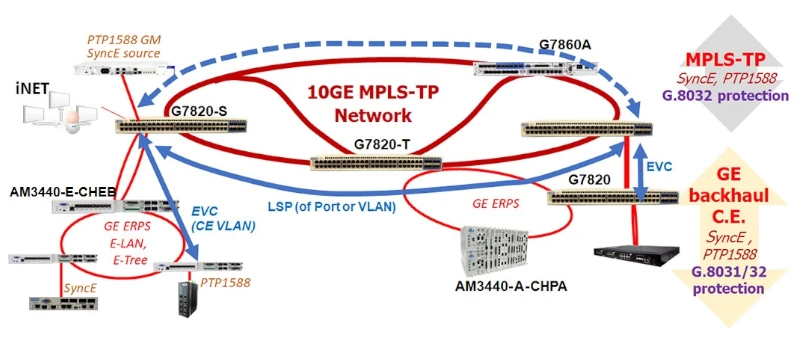
Ring-based metro networks implement Spanning Tree Protocol (RSTP/MSTP) and provider bridge ring protection (G.8032) for fast convergence (<50ms) upon ring segment failure.
Service Redundancy
Multiple parallel EVCs between the same customer endpoints enable active-active or active-standby service configurations with automatic failover to backup paths.
Diversity Requirements
Geographic and infrastructure diversity ensures that working and protection paths do not share common single-point failures, guaranteeing end-to-end resilience.
Advanced Features
Multicast Support
Native Layer 2 multicast forwarding enables efficient bandwidth utilization for point-to-multipoint applications including IPTV, video distribution, and collaborative services.
Network Time Synchronization
Precision Time Protocol (PTP) and Network Time Protocol (NTP) enable sub-microsecond clock synchronization for applications requiring precise timing correlation.
MPLS Integration
Carrier Ethernet services can be transported over MPLS-TP backbone networks, combining packet efficiency with circuit-like service semantics.
Connection Oriented Ethernet (CoE)
Explicit virtual connection establishment and teardown procedures enable fine-grained service management with on-demand provisioning capabilities.
Service Level Management
Automated provisioning, monitoring, and SLA enforcement through management platforms ensure consistent service delivery and rapid issue resolution.
Transparent LAN Services
Complete preservation of customer MAC frames and VLAN tags enables transparent network extension where customer LAN appears unchanged at remote sites.
Bandwidth Hierarchy & Performance
Standard Carrier Ethernet Rates
- •10 Mbps / 100 Mbps: Small office/remote locations
- •1 Gbps: Enterprise and data center networks
- •10 Gbps: Metropolitan backbone and core networks
- •40/100 Gbps: Ultra-high-capacity core infrastructure
Typical Performance Characteristics
- •Latency: 1-50ms (network dependent)
- •Jitter: <5ms (under normal conditions)
- •Packet Loss: <0.1% (99.9% delivery)
- •Availability: 99.99% - 99.999% uptime
Technology Comparison
| Characteristic | Carrier Ethernet | Best-Effort Internet |
|---|---|---|
| Bandwidth Guarantees | Committed & Peak rates | Variable/Best-effort |
| QoS Predictability | Deterministic SLAs | No guarantees |
| Service Levels | Contractual commitments | None |
| Latency Control | Bounded maximum | Unbounded variation |
| Traffic Isolation | Per-service VLAN/EVC | No isolation |
| Cost Model | Premium for guarantee | Economy pricing |
Ideal Applications
Telecommunications Operators
Service providers offering scalable, cost-effective transport with SLA guarantees to enterprise customers and other carriers
Enterprise Networks
Multi-location organizations requiring guaranteed WAN connectivity with simplified management and predictable performance
Data Center Networking
Cloud and hosting providers requiring high-speed, deterministic inter-facility connectivity and customer-facing network services
Content Distribution
Media and entertainment networks distributing IPTV, video streaming, and multicast content with QoS guarantees