MPLS-TP
Multiprotocol Label Switching - Transport Profile for Modern Carrier Networks
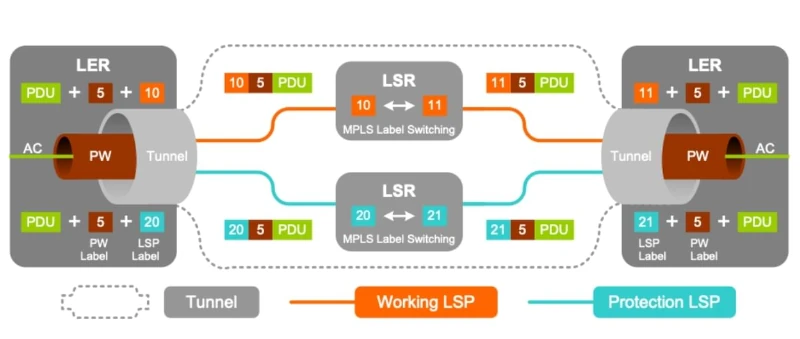
Overview
Multiprotocol Label Switching - Transport Profile (MPLS-TP) represents a packet-based transport architecture designed specifically for carrier-grade networks requiring deterministic service delivery. MPLS-TP combines the efficiency and flexibility of packet-based forwarding with the operational characteristics and protection mechanisms traditionally associated with circuit-oriented transport technologies.
MPLS-TP is standardized through the Internet Engineering Task Force (IETF) and provides an alternative transport solution that bridges the gap between legacy SDH/SONET networks and modern packet-based infrastructure, offering carrier operators enhanced flexibility without compromising reliability or service quality.
Core Characteristics
Packet-Based Transport
MPLS-TP operates at Layer 2.5, enabling efficient forwarding of variable-length packets through label-based switching rather than traditional IP routing, providing reduced overhead and improved performance compared to pure IP networks.
- •Hardware-accelerated label switching
- •Support for variable-length packets
- •Efficient bandwidth utilization
Carrier-Grade Operations
MPLS-TP incorporates operational concepts from carrier networks ensuring compatibility with existing telecommunications infrastructure and operational procedures.
- •Circuit-like service semantics
- •Deterministic service delivery
- •Operator-friendly management interfaces
Service Models
Point-to-Point (P2P)
Unidirectional or bidirectional virtual connections between two endpoint nodes with fixed bandwidth allocation and dedicated forwarding paths.
Use case: Leased line replacement, VPN connectivity
Point-to-Multipoint (P2MP)
Single source transmits to multiple destination nodes via a shared tree structure with efficient bandwidth utilization across common segments.
Use case: Broadcast, multicast applications, video distribution
Multipoint-to-Multipoint (MP2MP)
Bidirectional communication between multiple endpoints with automatic forwarding tree construction and traffic replication.
Use case: Virtual LAN extensions, collaborative networks
Traffic Engineering & Optimization
MPLS-TP provides sophisticated traffic engineering capabilities enabling network operators to optimize resource utilization and control traffic distribution:
Explicit Route Control (ERO)
Network administrators specify explicit forwarding paths for individual MPLS-TP circuits, enabling precise control over traffic routing and load distribution across network resources.
Bandwidth Management
Per-circuit bandwidth reservation with constraint-based routing ensures that new circuits are placed only on network segments with sufficient available capacity, preventing oversubscription.
Path Optimization
Automatic path selection algorithms balance network load across available routes, optimizing latency, reducing congestion, and improving overall network efficiency.
QoS Integration
Quality-of-service parameters are bound to individual MPLS-TP circuits, ensuring consistent performance characteristics regardless of other network traffic.
Protection & Restoration Mechanisms
Fast Reroute (FRR)
Local protection mechanism where alternate pre-computed paths are activated immediately upon link failure detection, with recovery times measured in milliseconds.
Protection Types:
- •Link Protection: Bypass alternate paths for failed links
- •Node Protection: Bypass alternate paths for failed nodes
Path Protection
End-to-end protection using completely disjoint working and protection paths computed at provisioning time, providing complete backup redundancy.
Characteristics:
- •1:1 or 1+1 protection models
- •Simultaneous traffic transmission or standby mode
- •Deterministic recovery characteristics
Ring Protection
Ring-based topologies incorporate inherent protection through bidirectional counter-rotating paths, enabling selective protection per circuit with bandwidth optimization. Compatible with SDH-SONET SNCP concepts, MPLS-TP ring protection provides automated failover within the ring topology.
Operations, Administration & Maintenance (OAM)
MPLS-TP incorporates comprehensive OAM functions inspired by SDH/SONET, providing in-band performance monitoring and fault detection:
Fault Management
- •Continuity check (CC) - detection of path connectivity failures
- •Remote defect indication (RDI) - notification of remote path failures
- •Path verification - validation of correct path traversal
Performance Monitoring
- •Packet loss measurement (LM)
- •One-way and round-trip delay measurement (DM)
- •Jitter and packet variation analysis
Diagnostic Functions
- •Loopback testing - isolation and diagnosis of path problems
- •Route tracing - determination of actual forwarding paths
- •Alarm indication signals (AIS) - fault notification propagation
Multiservice Traffic Support
MPLS-TP provides a unified transport platform for diverse traffic types:
Traditional TDM/PDH
Transport of legacy E1/T1 and E3/T3 circuits with transparent pseudowire encapsulation, enabling seamless integration with existing telecommunications infrastructure.
- • E1/T1 voice and signaling
- • CAS and PRI signalization
- • E3/T3 trunk circuits
ATM & Frame Relay
Pseudowire transport of ATM cells and Frame Relay frames preserving original protocol semantics and performance characteristics.
- • ATM cell transport
- • Frame Relay DLCI transport
- • Protocol transparency
Ethernet Services
Native Ethernet packet transport with support for various service models and advanced Layer 2 switching capabilities.
- • Raw Ethernet frame transport
- • VLAN preservation and manipulation
- • MAC-based switching
IP/MPLS Traffic
Native IP packet routing and MPLS tunnel support within MPLS-TP infrastructure for converged network operation.
- • IPv4 and IPv6
- • MPLS label stacking
- • QoS preservation
MPLS-TP vs. SDH/SONET
| Characteristic | MPLS-TP | SDH/SONET |
|---|---|---|
| Protocol Type | Packet-based (Layer 2.5) | Circuit-based (Layer 1) |
| Bandwidth Efficiency | Variable packet sizes, high efficiency | Fixed timeslots, deterministic |
| Synchronization | Optional (for TDM services) | Mandatory (core function) |
| Protection | FRR, Path protection, Ring | MSP, SNCP, MS-SPRing |
| OAM | Inspired by SDH/SONET | In-band overhead channels |
| Legacy Support | Via pseudowires | Native (primary design goal) |
MPLS-TP Advantages
- ✓Flexible bandwidth utilization with variable-length packets
- ✓Simplified network architecture (single technology stack)
- ✓Rapid service provisioning and modification
- ✓Enhanced multicast and P2MP capabilities
- ✓Sophisticated traffic engineering and optimization
- ✓Carrier-grade OAM and fault management
- ✓Legacy protocol support via pseudowires
- ✓Future-proof technology aligned with packet networking trends
Ideal Applications
Carrier Networks
Next-generation carrier networks replacing SDH/SONET infrastructure with packet-based technology while maintaining operational procedures
Metropolitan Networks
Metro and regional networks requiring flexible bandwidth allocation and simplified management compared to traditional circuit switching
Hybrid Environments
Networks supporting mixed traffic types (TDM, Ethernet, IP) requiring unified transport platform and consistent management
Enterprise & Data Centers
Large enterprises and data center operators requiring high-performance deterministic networks with advanced multicast capabilities